September 7, 2014


May 29, 2014
THE SCIENCE BEHIND TEMPLE BELLS

THE SCIENCE BEHIND TEMPLE BELLS
Most of the old temples have large bell at the entrance of the temple and you need to ring it before you enter temple. A Temple bell have a scientific phenomena; it is not just your ordinary metal. It is made of various metals including cadmium, lead, copper, zinc, nickel, chromium and manganese. The proportion at which each one of them mixed is real science behind a bell. Each of these bells is made to produce such a distinct sound that it can create unity of your left and right brain. The moment you ring that bell, bell produces sharp but lasting sound which lasts for minimum of seven seconds in echo mode good enough to touch your seven healing centres or chakras in your body. The moment bell sound happens your brain is emptied of all thoughts. Invariably you will enter state of Tran’s state where you are very receptive. This Trans state is the one with awareness. You are so occupied in mind that only way to awaken you is with a Shock! Bell works as Anti-dote to your mind. Before you enter temple – to awake you and prepare you for taste of awareness is the real reason behind temple bell.
SHARE and make others know about it !
http://hinduadhyathmikam.blogspot.com
May 21, 2014
How should a husband and wife behave with each other after marriage ?

Hindu religion teaches us that marriage is not just between two people, but an union of two families !
Let us understand and practice these guidelines given to lead a happy married life :
1. They should display a sensibility to understand each other.
2. They should appreciate each other’s qualities ; ignoring and not pointing out each other’s mistakes.
3. They should accept their mistakes.
4. They should have an attitude of sacrifice for one another.
5. They should love each other selflessly and without expectations.
6. They should share the happiness and unhappiness of the partner.
7. They should appreciate the abilities of the partner.
8. Never compare with someone else’s partner.
9. Behave respectfully with the partner’s parents and relatives.
10. They should not live in the past by digging out old disputes but enjoy life by remaining in the present times.
11. Celebrate the wedding anniversary, birthday of the partner and children.
February 6, 2014
A Sacred Time to Honor Our Ancestors: Pitru Paksha
The Indian or Vedic calendar is lunar based, unlike the Gregorian calendar. The observances during each month are usually spiritually or religiously based and rooted in deep tradition.
Sunday, September 30, 2012 marks the beginning of two weeks of Pitru Paksha (Pitt-true Puck-shuh), or Shraadh, which is a time dedicated to honoring our ancestors. This includes our blood relatives as well as significant teachers in our lives. It’s a time of remembrance and of offering our gratitude. Indians participate in special rituals and rites during this time. There are specific chants and mantras which are recited during this period.
Sunday, September 30, 2012 marks the beginning of two weeks of Pitru Paksha (Pitt-true Puck-shuh), or Shraadh, which is a time dedicated to honoring our ancestors. This includes our blood relatives as well as significant teachers in our lives. It’s a time of remembrance and of offering our gratitude. Indians participate in special rituals and rites during this time. There are specific chants and mantras which are recited during this period.
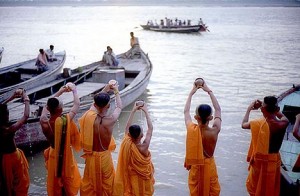
This is a time when individuals focus on their spiritual practices and meditation. It is typically not a time to commence new ventures or to enter into new agreements. Air travel should also be minimized as much as possible, unless it is for spiritual purposes (i.e. a pilgrimage).
Families pay homage to relatives who have passed on and they do so on the specific phase of the moon (the tithi) which coincides with the day that the person left his/ her body. Special meals are also prepared for these days, according to tradition. Offerings are made to ancestors at the bank of a river.
Pitru Paksha commences on the first day of the waxing (dark phase) Moon in the Vedic lunar month of Bhadrapada each year. Pitru Paksha continues through October 14th for Hawaii, Pacific, Mountain and Central time zones of North America) (or 15th for Eastern time zone in North America and other parts of the world). The festival of Navaratri follows Pitru Paksha.
September 21, 2013
Vedic Wisdom Behind Eating With Your Hands
Eating food with the hands in today’s Western society can sometimes be perceived as being unhygienic, bad mannered and primitive. However within Indian culture there is an old saying that,” Eating food with your hands feeds not only the body but also the mind and the spirit”.
In the Big Brother series some years back, an English participant complained about an Indian participants use of her hands during food preparations and her eating habits, “They eat with their hands in India, don’t they? Or is that China? You don’t know where those hands have been.” Within many Indian households nowadays, the practice of eating food with the hands has been replaced with the use of cutlery.
Have you ever thought of why previous generations in India ate with the hands? There is a reason for their this. The practice of eating with the hands originated within Ayurvedic teachings. The Vedic people knew the power held in the hand.

The ancient native tradition of eating food with the hands is derived from the mudra practice, which is prevalent in many aspects within Hinduism. Mudras are used during mediation and are very prominent within the many classical forms of dance, such as Bharatnatyam.
The hands are considered the most precious organ of action. This is linked to the Vedic prayer of
“Karagre vasate Laksmih karamule Sarasvati Karamadhye tu Govindah prabhate karadarsanam”
(On the tip of your fingers is Goddess Lakshmi, on the base of your fingers is Goddess Saraswati; in the middle of your fingers is Lord Govinda), which we recite whilst looking at our palms. Thus, this shloka suggests that all the divinity lies in human effort.
Our hands and feet are said to be the conduits of the five elements. The Ayurvedic texts teach that each finger is an extension of one of the five elements. The thumb is agni (fire) (you might have seen children sucking their thumb, this is nature’s way of aiding the digestion in children at an age when they are unable to do an physical activity to aid the digestion), the forefinger is vayu (air), the middle finger is akash (ether - the tiny intercellular spaces in the human body), the ring finger is prithvi (earth) and the little finger is jal (water).
Each finger aids in the transformation of food, before it passes on to internal digestion. Gathering the fingertips as they touch the food stimulates the five elements and invites Agni to bring forth the digestive juices. As well as improving digestion the person becomes more conscious of the tastes, textures and smells of the foods they are eating, which all adds to the pleasure of eating.
You may have noticed that elders in the family hardly ever use utensils to measure all the different type of masala, and would instead prefer to use their hands to measure the quantity instead. As each handful is tailored to provide a suitable amount for the own body. Overall there are 6 main documented forms that the hands take when obtaining a measurement a certain type of food ranging from solid food to seeds, and flour.
This is a prime example of how many things within Hindu culture may seem weird and unusual at first glance, but once a closer look is taken it is surprising, but a vast amount of knowledge is revealed.
September 5, 2013
JAMBUDWIPA AND THE SANKALPA
All of us would have probably heard the words, ".....Jambudveepe Bharatha Varshe Bharata Khande....." during the sankalpa mantram which forms an integral part of all Vedic rituals. However, most people in foreign countries regularly come to our page with the doubt as to how they must modify this sankalpa mantra to suit the etymology of those countries. This post hopes to throw some light on this aspect.
What exactly is this "Jambudwipa"?
Jambudveepa consisted of modern Asia, Europe, Africa and North America and not merely the Indian subcontinent.
This Jambudvipa was divided into nine varshas (geographical regions) of which one was Bharatha Varsha. The other eight varshas were:
2.Ketumula Varsha
3.Hari Varsha
4.Ilavrita Varsha
5.Kuru Varsha
6.Hiranyaka Varsha
7.Ramyaka Varsha
8.Kimpurusha Varsha
9.Bhadrasva Varsha.
(Refer to the picture to get a clear idea of this).
India which was then called Bharathavarsha extended in the west including the regions of modern Egypt, Afghanistan, Baluchistan, Iran, Sumeria upto Caspian Sea (which was called Kashyapa Samudra in those days). Within this Bharata Varsha was located the Bharata Khanda which was the heart of the Vedic civilization & the place where we Indians currently reside. This is one of the innumerous proofs that the Indo-Aryan race theory is a conspiracy theory moulded by western countries to show us in poor light. All of the regions so mentioned in the race theory are a part of Bharata Varsha & there was never a so called "invasion".
What is amazing is the fact that our ancestors had an excellent overview of the geography of the world back then.
It can be observed that in those times, most of South American continent, southern half of African Continent and entire Australia were submerged under water. On the other hand most of modern day Atlantic ocean and Pacific ocean, and the entire Arctic ocean were above sea level.
This also proves the logical fallacy of the Western missionaries which claim that the Vedic civilization is just 5000 years old, Kurukshetra war took place just a few thousand years back,etc. The vedic civilization existed at times when Australia was submerged below the ocean! Imagine how long back that must have been!
What is rather disappointing is the fact that our government to this day teaches all sorts of disproved, anti-Indian & illogical theories in our textbooks solely for "minority appeasement" & to support the slow conversion on Hindus to Christianity, a mission well sponsored by the missionaries of the West.
The credits for this discovery go to the great soul Lokamanya Balagangadhar Tilak. More info can be found in his book �The Arctic Home in the Vedas�.
Its disgusting that our government teaches our younger generations to think how worthless our ancestors were rather than teaching them about these great discoveries by such patriots.
I am reminded of the time when the Congress & other pseudosecular parties cried about "Saffronisation of India!" when LK Advani made a proposal to introduce lessons about the great sages of our country. Its time we wake up & understand who is ruling us & what their true agenda is. Are our sages not Indians? Can you name one country which shows its own personalities in poor light to appease its minorities(although minorities are not at all benefitted by it!)?
Its not that we are siding with any political party, but we shall certainly not accept those parties which intend to slowly destroy Sanatana Dharma through covert means!
||JAI PARSHURAM||
August 22, 2013
Why to visit Temple?
There are thousands of temples all over India in different size, shape and locations but not all of them are considered to be built the Vedic way. Generally, a temple should be located at a place where earth's magnetic wave path passes through densely. It can be in the outskirts of a town/village or city, or in middle of the dwelling place, or on a hilltop. The essence of visiting a temple is discussed here.
Now, these temples are located strategically at a place where the positive energy is abundantly available from the magnetic and electric wave distributions of north/south pole thrust. The main idol is placed in the core center of the temple, known as "*Garbhagriha*" or *Moolasthanam*. In fact, the temple structure is built after the idol has been placed. This *Moolasthanam* is where earth’s magnetic waves are found to be maximum. We know that there are some copper plates, inscribed with Vedic scripts, buried beneath the Main Idol. What are they really? No, they are not God’s / priests’ flash cards when they forget the *shlokas*. The copper plate absorbs earth’s magnetic waves and radiates it to the surroundings. Thus a person regularly visiting a temple and walking clockwise around the Main Idol receives the beamed magnetic waves and his body absorbs it. This is a very slow process and a regular visit will let him absorb more of this positive energy. Scientifically, it is the positive energy that we all require to have a healthy life.

Further, the Sanctum is closed on three sides. This increases the effect of all energies. The lamp that is lit radiates heat energy and also provides light inside the sanctum to the priests or *poojaris* performing the pooja. The ringing of the bells and the chanting of prayers takes a worshipper into trance, thus not letting his mind waver. When done in groups, this helps people forget personal problems for a while and relieve their stress. The fragrance from the flowers, the burning of camphor give out the chemical energy further aiding in a different good aura. The effect of all these energies is supplemented by the positive energy from the idol, the copper plates and utensils in the *Moolasthan*am / *Garbagraham*. *Theertham*, the “holy” water used during the pooja to wash the idol is not
plain water cleaning the dust off an idol. It is a concoction of Cardamom,*Karpura* (Benzoin), zaffron / saffron, *Tulsi* (Holy Basil), Clove, etc...Washing the idol is to charge the water with the magnetic radiations thus increasing its medicinal values. Three spoons of this holy water is distributed to devotees. Again, this water is mainly a source of magneto-therapy. Besides, the clove essence protects one from tooth decay, the saffron & *Tulsi* leafs protects one from common cold and cough, cardamom and *Pachha Karpuram* (benzoin), act as mouth fresheners. It is proved that *Theertham* is a very good blood purifier, as it is highly energized. Hence it is given as *prasadam* to the devotees. This way, one can claim to remain healthy by regularly visiting the Temples. This is why our elders used to suggest us to offer prayers at the temple so that you will be cured of many ailments. They were not always superstitious. Yes, in a few cases they did go overboard when due to ignorance they hoped many serious diseases could be cured at temples by deities. When people go to a temple for the *Deepaaraadhana*, and when the doors open up, the positive energy gushes out onto the persons who are there. The water that is sprinkled onto the assemblages passes on the energy to all. This also explains why men are not allowed to wear shirts at a few temples and women are requested to wear more ornaments during temple visits. It is through these jewels (metal) that positive energy is absorbed by the women. Also, it is a practice to leave newly purchased jewels at an idol’s feet and then wear them with the idol’s blessings. This act is now justified after reading this article. This act of “seeking divine blessings” before using any new article, like books or pens or automobiles may have stemmed from this through mere observation.
Energy lost in a day’s work is regained through a temple visit and one is refreshed slightly. The positive energy that is spread out in the entire temple and especially around where the main idol is placed, are simply absorbed by one's body and mind. Did you know, every Vaishnava(Vishnu devotees), “must” visit a Vishnu temple twice every day in their location. Our practices are NOT some hard and fast rules framed by 1 man and his followers or God’s words in somebody’s dreams. All the rituals, all the practices are, in reality, well researched, studied and scientifically backed thesis which form the ways of nature to lead a good healthy life.
The scientific and research part of the practices are well camouflaged as “elder’s instructions” or “granny’s teaching’s” which should be obeyed as a mark of respect so as to once again, avoid stress to the mediocre brains.
Source: https://www.facebook.com/photo.php?fbid=623251094371958&set=a.478319532198449.110676.478241992206203&type=1
Now, these temples are located strategically at a place where the positive energy is abundantly available from the magnetic and electric wave distributions of north/south pole thrust. The main idol is placed in the core center of the temple, known as "*Garbhagriha*" or *Moolasthanam*. In fact, the temple structure is built after the idol has been placed. This *Moolasthanam* is where earth’s magnetic waves are found to be maximum. We know that there are some copper plates, inscribed with Vedic scripts, buried beneath the Main Idol. What are they really? No, they are not God’s / priests’ flash cards when they forget the *shlokas*. The copper plate absorbs earth’s magnetic waves and radiates it to the surroundings. Thus a person regularly visiting a temple and walking clockwise around the Main Idol receives the beamed magnetic waves and his body absorbs it. This is a very slow process and a regular visit will let him absorb more of this positive energy. Scientifically, it is the positive energy that we all require to have a healthy life.
Further, the Sanctum is closed on three sides. This increases the effect of all energies. The lamp that is lit radiates heat energy and also provides light inside the sanctum to the priests or *poojaris* performing the pooja. The ringing of the bells and the chanting of prayers takes a worshipper into trance, thus not letting his mind waver. When done in groups, this helps people forget personal problems for a while and relieve their stress. The fragrance from the flowers, the burning of camphor give out the chemical energy further aiding in a different good aura. The effect of all these energies is supplemented by the positive energy from the idol, the copper plates and utensils in the *Moolasthan*am / *Garbagraham*. *Theertham*, the “holy” water used during the pooja to wash the idol is not
plain water cleaning the dust off an idol. It is a concoction of Cardamom,*Karpura* (Benzoin), zaffron / saffron, *Tulsi* (Holy Basil), Clove, etc...Washing the idol is to charge the water with the magnetic radiations thus increasing its medicinal values. Three spoons of this holy water is distributed to devotees. Again, this water is mainly a source of magneto-therapy. Besides, the clove essence protects one from tooth decay, the saffron & *Tulsi* leafs protects one from common cold and cough, cardamom and *Pachha Karpuram* (benzoin), act as mouth fresheners. It is proved that *Theertham* is a very good blood purifier, as it is highly energized. Hence it is given as *prasadam* to the devotees. This way, one can claim to remain healthy by regularly visiting the Temples. This is why our elders used to suggest us to offer prayers at the temple so that you will be cured of many ailments. They were not always superstitious. Yes, in a few cases they did go overboard when due to ignorance they hoped many serious diseases could be cured at temples by deities. When people go to a temple for the *Deepaaraadhana*, and when the doors open up, the positive energy gushes out onto the persons who are there. The water that is sprinkled onto the assemblages passes on the energy to all. This also explains why men are not allowed to wear shirts at a few temples and women are requested to wear more ornaments during temple visits. It is through these jewels (metal) that positive energy is absorbed by the women. Also, it is a practice to leave newly purchased jewels at an idol’s feet and then wear them with the idol’s blessings. This act is now justified after reading this article. This act of “seeking divine blessings” before using any new article, like books or pens or automobiles may have stemmed from this through mere observation.
Energy lost in a day’s work is regained through a temple visit and one is refreshed slightly. The positive energy that is spread out in the entire temple and especially around where the main idol is placed, are simply absorbed by one's body and mind. Did you know, every Vaishnava(Vishnu devotees), “must” visit a Vishnu temple twice every day in their location. Our practices are NOT some hard and fast rules framed by 1 man and his followers or God’s words in somebody’s dreams. All the rituals, all the practices are, in reality, well researched, studied and scientifically backed thesis which form the ways of nature to lead a good healthy life.
The scientific and research part of the practices are well camouflaged as “elder’s instructions” or “granny’s teaching’s” which should be obeyed as a mark of respect so as to once again, avoid stress to the mediocre brains.
Source: https://www.facebook.com/photo.php?fbid=623251094371958&set=a.478319532198449.110676.478241992206203&type=1
August 4, 2013
Classification of Hindu Ancient Vedas Ithihasas Puranas
 |
| Classification of Hindu Ancient Puranas & Vedas |
May 29, 2013
Reason for Tonsure or Shaving Head in Tirumala
Reason for Tonsure or Shaving Head in Tirumala

When Lord Sri Venkatesha (MahaVishnu/Balaji) was inside the snake-antHill on tirumala, one sacred cow is to come and give milk to the Lord daily (Brahma deva took the form as sacred cow), When a cow-herd man at once saw the sacred-cow pouring milk in the snake-antHill, he became angry and without understanding the truth, the Cow-herd man took the axe and has hit the cow on the cow’s head with the axe. The Supreme Lord Sri Venkatesha(Vishnu) who was present inside the snake-antHill received the hurt of the axe on his head from the cow-herd man instead of Cow getting hurt. When Lord received the hurt of the Axe on his head, portion of his hair on his head disappeared due to hurt by axe. When mother Neela Devi saw Lord being hurt on his head, she immediately removed the hair from her head and placed on the Lord’s head in the portion where lord was hurt. Immediately Lord became well and Lord’s hair reappeared as beautiful as before he was hurt. Lord Venkatesha(Vishnu) knowing that hair is one of the beautiful features of women, Lord Sri venkatesha promised that his devotees will shave Hair of their head (tonsure) and dedicate their hair to her. Neela Devi accepts the hair sacrificed by Devotees of Lord Venkatesha(Vishnu) and Lord blesses his devotees who sacrifice their hair for the sake of the Lord. This is the reason why Devotees tonsure or shave their head in Tirumala(tirupathi).
There are also Spiritual reasons: Tonsure or Saving hair as offering for Lord represents a real sacrifice of material beauty and giving up false-ego in the way of shaving their hair as sacrifice to please Supreme Lord.
Source: http://www.flickr.com/photos/yeshwanth/4378358918/
Source: http://www.flickr.com/photos/yeshwanth/4378358918/
February 21, 2013
Bheeshma Ekadashi
భీష్మ ఏకాదశి- పరమ పవిత్రమైన రోజు:-

ఈ రోజు భీష్మ ఏకాదశి. మాఘ శుక్ల ఏకాదశినే భీష్మ ఏకాదశి అంటాము. ఈ రోజునే విష్ణు సహస్ర నామం ఉద్భవించింది. విచిత్ర మైన ఘట్టం. ఒళ్ళంతా బాణాలు దిగి అంప శయ్య మీద ఉన్న ఆజన్మ బ్రహ్మ చారి. అష్ట వసువులలో ఒకడు. అతి పుణ్యాత్ముడు అయిన భీష్మ పితామహుడు. ప్రశ్నలు అడుగటానికి వచ్చింది ధర్మరాజు.ఎవరితో? అదే బాణాలు సంధించిన అర్జునుడు ఇతరులతో కలసి . తోడుకొని వచ్చింది "కృష్ణస్తు భగవాన్ స్వయం" అనబడే సాక్షాత్తూ భగవంతుని పూర్ణ అవతారం శ్రీ కృష్ణుడు.
భీష్ముడు ఇచ్చా మరణ వరం కలవాడు. అంటే అనుకున్నపుడే మరణించ గలడు. ఉత్తరాయణ పుణ్య కాలం కోసం ఎదురు చూస్తూ 50 రోజులు వంటిలో దిగిన బాణాలతో అంప శయ్య మీద వేచి వున్నాడు. చివరికి ఈ రోజు పవిత్ర మైన విష్ణు సహస్ర నామములను ఉపదేశించాడు ధర్మరాజుకు. భగవంతుడైన శ్రీ కృష్ణుడు చిరు నవ్వు తో విని ఆమోదించాడు. ఇట్టి మహత్తర ఘట్టం ఎక్కడా లేదు. భగవంతుని దివ్య నామములను స్వయానా భగవంతుడే విని దీవించిన అపూర్వ ఘట్టం.
శ్రుత్వా ధర్మా నషేశేన పావనాని చ సర్వశః యుధిష్టిర స్సాన్తనవం పునరేవాభ్య భాషత --భీష్ముడు చెప్పిన నానా ధర్మాలను విన్న ధర్మరాజు చివరగా. కొన్ని ప్రశ్నలు అడుగుతాడు.
కిమేకం దైవతం లోకే? కిం వాప్యేకం పారాయణం? స్తువంత కం కమర్చంత ప్రాప్నుయుర్మానవా శుభం? కో ధర్మ సర్వ ధర్మానాం భవత పరమో మతః. కిం జపన్ ముచ్యతే జంతు జన్మ సంసార బంధనాత్.?
లోకంలో ఎవరు దైవము? ఎవరిని పూజించి, స్తుతించి అర్చించాలి. దేనివల్ల మానవులకు శుభం కలుగుతుంది. అన్ని ధర్మములలోకి ఉత్తమ ధర్మమేది. దేనిని జపించుట వలన మనిషి సంసార బంధముల నుండి విముక్తి పొందుతాడు? అని.
దానికి భీష్మ పితామహుడు , జగత్ ప్రభుం దేవదేవం అనంతం పురుషోత్తమం అని చెబుతూ,
అనాది నిధనం విష్ణుం సర్వ లోక మహేశ్వరం
లోకాధ్యక్షం స్తువన్నిత్యం సర్వ దుఖాతిగో భవేత్.
ఆది అంతము లేని, సర్వ వ్యాపి అయిన, దేవ దేవుడైన , భగవంతుడైన విష్ణు స్తుతి వల్ల సర్వ దుఃఖములు తోలగుతవి- అని ఇంకా చెబుతూ
ఎషమే సర్వ ధర్మానాం ధర్మోధిక తమో మతః- ఇదియే అన్ని ధర్మములలోకి ఉత్తమ ధర్మమని నా మాట అంటాడు.
నన్ను అనుగ్రహించిన సద్గురువులలో ఒకరైన, మహా తపస్వి, పరమ పూజ్య నందానంద స్వామి ఒక రోజు దీనిని నాకు వివరిస్తూ, సత్యా, పరమం యో మహత్తేజః పరమం యో మహత్తపః- ఏది పరమమైన తెజమో, ఏది పరమ మైన తపమో అట్టి దివ్యము తేజోమయము అయిన మంగళ స్వరూపాన్ని ధ్యానించు అన్నారు.
ముఖ్యం గా విష్ణు సహస్ర నామ జపం, ధ్యానం వల్ల భయం తొలగుతుంది, శుభం కలుగుతుంది. గణపతిని,వ్యాస భగవానుని,పితామహుని,పాండవులను, తల్లి తండ్రులను, గురువులను భక్తీ పూర్వకంగా స్మరించి తదుపరి , ఈ దివ్య నామములను జపిస్తూ తేజో మయుడైన, పరమాత్ముని ధ్యానించి బాధల నుంచి విముక్తుల మవుదాం.
ఆంధ్రరాష్ట్రంలోని ఒక్కో ప్రాంతంలోని విశిష్ట ఆలయాలకు భీష్మ ఏకాదశి సందర్భంగా ప్రత్యేక పూజలు జరుగుతుంటాయి. సత్యనారాయణ స్వామి వెలసిన అన్నవరంలో, విజయనగరంలో ఈ పర్వదినం పాటించే విధానాన్ని ఇప్పుడు చూద్దాం. పాండవుల అభిమాని అయిన భీష్ముడు అంపశయ్యపై ఉండి ఉత్తరాయణ పుణ్యకాలం కోసం ఎదురుచూసే రోజుల్లో ధర్మరాజుకు ‘విష్ణు సహస్త్రనామాలు’ బోధించాడు. ఈ నామాలు గోప్యమయినవే కాదు గొప్పవి కూడా.
ఈ నామాలకే ఆదిశంకరాచార్యులు భాష్యం చెప్పారు. ఈ నామాల సుస్వరాలాపనే ‘సత్యనారాయణ వ్రతం’. ఈ వ్రతాన్ని భీష్మ ఏకాదశి రోజున ఆచరిస్తే కోరుకున్నవి నెరవేరుతాయని పెద్దల నమ్మకం. అందుకే అన్నవరంలోని సత్యనారాయణ స్వామిని భీష్మ ఏకాదశి రోజున భక్తులు పెద్ద సంఖ్యలో దర్శిస్తారు. వ్రతాన్ని ఆచరిస్తారు.
భీష్మ ఏకాదశిరోజున అన్నవరం భక్తులతో కళకళలాడుతుంది. విజయనగరం, విశాఖపట్నం, శ్రీకాకుళం ప్రాంతాలకే పరిమితమైన జానపద కళారూపం ‘తప్పెట గుళ్ళు’. ఈ కళారూపం ప్రదర్శనను గంగమ్మ దేవతకు నివేదించిన తర్వాత తప్పెట గుళ్ళు వాయించడాన్ని భక్తులంతా ‘పూజ’గా భావిస్తారు.
January 29, 2013
Bhajagovindam - Meaning
Bhajagovindam Bhajagovindam
Govindam Bhaja Moodhamathe
Govindam Bhaja Moodhamathe
Samprapte Sannihite Kaale
Nahi Nahi Rakshati Dukrinkarane
Meaning:
Bhaja - Seek, Govinda - The Lord Govinda, Moodhamathe - O Fool, O Ignoramus, Samprapte - (When) comes, Sannihite - appointed, Kaale - Time, Nahi - Surely never, Rakshati - Saves, Dukrinkarane - Grammar rule.
Substance:
Seek or Worship Govinda, Seek Govinda, Seek Govinda, O Fool or ignoramus. When the death comes at the appointed time, grammar rules will not save or rescue you..
Commentary:
By repeating the words "Bhaja Govindam" thrice in the very first two lines of the first sloka itself, Jagatguru Sri Adi Sankaracharya is trying to bring home the point that human being has no other escape except immersing oneself in the thoughts of Lord, and praying with utmost sincerity, reciting the Divine Namas of the Lord rather than getting engrossed in anxieties to possess wealth or acquire social status or achievements. Here the rules of grammar mean all secular knowledge and earthly acquisitions or possessions. The one who runs after materialistic gains is Moodhamathi.
The purport of these words is that any amount of knowledge cannot save the soul when death knocks at the door of this limited body. At that time, one has to leave behind one's material benefits and social status. These acquisitions will not help one gain the knowledge of the Soul, which is permanent, when the impermanent body withers, it turns out to be a dead-wood.
It does not mean that one should shun away the pursuit of living for knowledge, but, at the same time, one should understand its limited capacity, and one should seriously try to acquire that knowledge which alone can save a person from the slavery of imperfections. We should remember the truth that it is a manifested world and it is impermanent. Other than God or Soul, everything else is temporary. Death will snatch away the existence of the body and the manifested world. What is the use of all the acquisitions and secural knowledge then? So, while living in this secular world, or materialistic world, one should endeavour to understand and master the secret of purposeful life. One should identify oneself with the Lord, who can only give solace to the parched materialistic lives. One should progress spiritually after each death, instead of getting deeper and deeper into mundane pleasures. It is rather sad that quite a few of us are of the opinion that spirituality is for those who retired from employment or aged people. The intellect, which has not been trained to remember God till one attains sixty years, will never resort to spirituality after that. Even if it does, for argument sake, what is guarantee that the cruel hands of death will not embrace one before that. So, one should understand the fallacy of this argument and train the mind from the childhood itself to start practicing recitation of the Lord's name with every breath that one inhales and exhales, otherwise it is just impossible to remember God's name at the time of death. It is, therefore, imperative that one should keep repeating the Divine Namas of Lord at every possible moment.
Bhaja does not mean monotonous and routine ritual with mechanical chanting of some selected Namas or Mantras. It is rather much deeper than that. The true Bhajan of Lord is to offer True Seva or Service to Lord with Love and devotion and in that sense, every human being is a Lord. Bhagavan is Bhava Graahi. He does not get enamoured or attracted by the pomp and show of the devotee. He looks deep into the heart of the devotee to see how much sincere one is while worshiping Him or serving the needy, treating them as (the) God Himself (i.e., Manava sevahi Madhava seva).
There are Nine types of Service to be offered at the feet of Lord. A devotee can adopt any one, according to one's choice and temperament.
They are :
(1) Sravanam (listening to the stories or glory of Lord),
(2) Keertanam (Singing the glory of the Lord),
(3) Smaranam (Constantly thinking about the nature and beauty, divine qualities and characteristics of the Lord,
(4) Paadasevaram (Adorning the sacred feet of Lord in a spirit of self-obliteration),
5) Archanam (Worshiping the Lord with rituals, mantras and with self-less love),
(6) Vandanam (Salute or to pay obeisance to the Lord),
(7) Dassyam (Serving the Lord),
(8) Sakhyam (Invoking an affectionate friendship with Lord, and
(9) Aatmanivedanam (To offer oneself with complete dedication or total surrender to the Lord as a humble gift at His altar). Every devotee has the liberty to choose a path that is convenient and appealing to one to realise the God.
In all the above modes of worship, the spirit of Bhaja is visible. With this bhava, the devotee has to worship the Govinda, who is the knower of each atom of this universe. He is the very essence of all animate and inanimate beings in this universe. So, Govinda is the Atman, Govinda is the Brahman, Govinda is the Highest Reality and the very Essence of this Universe. Each devotee should seek one's identity with that Spirit, Force, Reality, Truth and Supreme Braman or God, instead of wasting one's time in materialistic pursuits of secular knowledge for worldly possessions, name and fame...!!!
Sorce:
https://www.facebook.com/notes/bhagavathi-charan-meda/bhaja-govindam-1/572233089457445
January 27, 2013
Hindu God - Lord Brahma
Brahma has four face though only three can be seen. He has matted hair, wears a pointed beard and the eyes are usually closed in meditation. He has four hands which may hold a variety of objects such as a rosary, a water-pot, a book (the Vedas), a sceptre, a spoon, a bow or a lotus. Sometimes two of his hands may be in a boon-giving and protective attitudes. His four faces represent the four Vedas and the four hands the four directions. The rosary which he is counting represents time. The whole universe evolves out of water, therefore Brahma carries water in the water-pot.
He may wear a tiger skin or the skin of a black antelope as a garment and the sacred cord over his left shoulder. If colored, he is pink or red. He is sometimes shown riding the goose, or sitting in the lotus position in a chariot being pulled by seven swans. The swan which is the symbol of knowledge, is his vehicle.
In the Rig-Veda the word Brahman (or Brahma) was used to indicate the mysterious power contained in sacred utterances. Later, this was associated with the skill of the priest who spoke the ‘words’ and he was described as a Brahmin. In the Upanishads, by a further development, this power was regarded as being universal and forming the elemental matter from which everything (including the gods themselves) originally emerged. Eventually this supreme creative spirit became fully personalized under the name of Brahma.

Since this idea is linked with the origin of the universe, it was inevitable that Brahma should become associated with Hindu cosmogony. Many legends grew, particularly in the later texts, surrounding the connection with the origin and control of the universe. In one of them the supreme soul and self-existent lord created the waters of the earth and deposited in them a seed which became the golden egg, out of which He was born as Brahma. According to other texts, he became a boar who raised the earth from the primeval waters and thus created the world. He is described as assuming the appearance of a fish or a tortoise at the beginning of the ages. In much later developments of Hindu mythology these aspects are attributed to Vishnu and Brahma assumes a secondary role. His worship slowly declined and has not been widespread since the 6th century.
He may wear a tiger skin or the skin of a black antelope as a garment and the sacred cord over his left shoulder. If colored, he is pink or red. He is sometimes shown riding the goose, or sitting in the lotus position in a chariot being pulled by seven swans. The swan which is the symbol of knowledge, is his vehicle.
In the Rig-Veda the word Brahman (or Brahma) was used to indicate the mysterious power contained in sacred utterances. Later, this was associated with the skill of the priest who spoke the ‘words’ and he was described as a Brahmin. In the Upanishads, by a further development, this power was regarded as being universal and forming the elemental matter from which everything (including the gods themselves) originally emerged. Eventually this supreme creative spirit became fully personalized under the name of Brahma.
Since this idea is linked with the origin of the universe, it was inevitable that Brahma should become associated with Hindu cosmogony. Many legends grew, particularly in the later texts, surrounding the connection with the origin and control of the universe. In one of them the supreme soul and self-existent lord created the waters of the earth and deposited in them a seed which became the golden egg, out of which He was born as Brahma. According to other texts, he became a boar who raised the earth from the primeval waters and thus created the world. He is described as assuming the appearance of a fish or a tortoise at the beginning of the ages. In much later developments of Hindu mythology these aspects are attributed to Vishnu and Brahma assumes a secondary role. His worship slowly declined and has not been widespread since the 6th century.
Images of Brahma are still made. Many temples include one somewhere in their scheme of sculptural decoration, although it is only in extremely rare cases that he occupies the position of the main icon. In the whole of India there are very few temples of Brahma. There is one at Pushkar, near Ajmer (Rajasthan) and another in Orissa.
In Hindu cosmology the basic cycle which through the cosmos, passes through all eternity, is the Kalpa or the Day of Brahma, equivalent to 4320 million years. A night is of equal length, and 360 days and nights of this duration form one year of Brahma’s life. This is expected to last 100 years.
In Hindu cosmology the basic cycle which through the cosmos, passes through all eternity, is the Kalpa or the Day of Brahma, equivalent to 4320 million years. A night is of equal length, and 360 days and nights of this duration form one year of Brahma’s life. This is expected to last 100 years.
Source:
http://history-of-hinduism.blogspot.in
Hanuman with his wife Suvarchala

The boons granted by the gods made Hanuman invincible. The monkey child became uncontrollable. He became very mischievous. His pranks irritated many. He did not spare the sages even. He would pounce on them and tear their dress. He would throw fruit and leaves, perched atop trees. They bore with him patiently being aware of his future. One day a sage was very much disturbed by Hanumantha. The sage went into a rage and cursed Hanumantha: “ May you forget your strength with which you have caused us so much of pain”. The curse changed the life of Hanuman altogether. He became very calm and inert. The change pained the sages. They altered the curse on him. They blessed him thus: “If any one reminds you of your strength, you would recognize your strength and abilities and succeed”.
This boon chastened Hanumantha. He became a well-behaved child and an epitome of virtuousness.
Hanuman was growing older. His mother told him: “Son! It is time to get educated. There is no better teacher than Surya, the Sun god, who dispels all darkness. Go to him and gain knowledge.”
Even though he was omnipotent, Hanuman obeyed his mother. He reached the Surya Mandala and humbly prayed the Sun god: “O! Surya Deva, I want to learn Vedas, Vedangas, and Upangas from you. Please teach me.” Surya replied: “O! Boy of Anjana, I am always on the move, as ordained by Almighty, how can I teach you? ”
Hanuman was angered. He blocked the path of Surya. Surya pacified Hanuman. He said: “I have no objection to teach you. But you have to find a way to learn”.
Hanuman stood facing the sun and started walking backwards. Surya was moving forward and was teaching Hanuman. Lord Siva is said to know all and Hanuman, who is Lord Siva’s incarnation, proved to be one who knows all as well. With in a week of his education, he astonished Surya. Surya praised Hanuman. Hanuman wanted to continue his education. Instead of walking backward, he put one foot on the rising hill and the other one on the setting hill to face the Sun god. Hanuman’s interest and devotion pleased the Sun god. Surya taught all that is to be taught to Hanuman.
Surya was married to Sanjana, a daughter of Viswakarma. Sanjana was devoted wife but was unable to bear the heat emanating from the Sun’s rays. She was suffering with anguish. Her mother noticed the daughter’s plight and sought to know as to what the problem was. Sanjana explained her problem to her mother. Her mother in turn told Viswakarma of Sanjana’s problem. Viswakarma told Surya that he would polish off some of the luminescence of Surya. Surya agreed. Viswakarma was able to polish off some luminescence of his son-in-law. The luminescence thus separated took the form of young woman. Her beauty and grace astonished even gods. Indra wanted to know as to who would marry that shinning brilliant young women. Brahma thought for a while and replied: “Hanuman who is essence of Lord Siva’s fiery power will marry the young woman. Since Hanuman tried to grab the ever glowing Sun god, he alone can bear this glowing young woman”.
Surya remembered Brahma’s utterance. By than Hanuman’s education was complete. He was ready to graduate. He bowed to Lord Surya and said: “O! My divine teacher! Thanks to you I am educated now. I would like to take your leave now. I would like to offer you an appropriate fee as Guru Dakshina. Kindly order me”.
Surya immediately replied: “O Hanuman, you are the incarnation of Lord Siva who bore the poisonous HAALAAHALA to save the universe when the ocean was churned. You are also son of Agni, the fire god. Viswakarma separated a part of my luminescence and the world is unable to bear it. You are the only one who can bear it. So I want to offer you my daughter Suvarchala formed from my ‘VARCHAS’ (luminescence), in marriage. Marry my daughter. Since husband is the one who is to bear, you also bear my ‘Suvarchas’ by marrying Suvarchala. Your marrying her shall be my Guru Dakshina”.
Hanuman listened to his teacher and replied politely: “O Lord! I have decided to follow Brahmacharya through out my life. How can I marry?” Surya replied: “O Hanuman, this Suvarchala is a divine one, Ayonija. She would be a devoted wife. I am giving you the boon that you would still be a Brahmachari even after marriage. You would continue to be a Prajapatya Brahmachari. Your marriage is only for the welfare of the Universe and it would not affect your chosen course of celibacy. You were a born Brahmachari with a Yajnopavita (Sacred thread). Brahmacharya will be your eternal pursuit. Since you are going to be a Brahma in future, Suvarchala will then occupy the place of Vani”.
Hanuman obeyed his preceptor’s advice. Surya presented Suvarchala to Hanuman. It is stated in PARASARA SAMHITA, that Surya offered his daughter Suvarchala in marriage on JYESTHA SUDDHA DASAMI. It was a Wednesday under the star UTTARA. Those who respect tradition, even to this day, observe “HANUMAT KALYANAM” (Hanuman’s Marriage) on JYESTHA SUDDHA DASAMI day.
January 25, 2013
Hinduism at a Glance
- The original name of Hinduism is Sanatan Dharm. ‘Sanatan’ means eternal and ‘Dharm’ means those actions, thoughts and practices that promote physical and mental happiness in the world and ensure God realization.
- Sanatan Dharm eternally exists in God, is revealed by God, describes the names, forms, virtues and the abodes of God, and reveals the true path of God realization for the souls of the world.

- There are three eternal existences: soul, maya, and God. Souls are unlimited in number, infinitesimal in size, Divine in quality but eternally under the bondage of maya. Soul does not belong to maya or the mayic world. It has a natural and eternal relationship with God.
- Maya is a lifeless power of God having three qualities: sattvic (pious), rajas (selfish) and tamas (impious) that represent its existence when it is evolved into the form of the universe. The universe has two dimensions -- material and celestial. The Divine dimension of God lies beyond the field of maya.
- Hinduism is monotheistic. There is one single God Who represents the various aspects of His unlimited Blissful charm through many forms such as Krishn, Vishnu, Shiv and Shakti and the impersonal aspect. Out of these Krishn is the absolute supreme form of God which includes all others. God is an eternal, omnipresent, all-Blissful, all-Gracious, all-kind and all-loving Divine personality.
- Hinduism explains that the soul is eternally yearning for perfect, unlimited and everlasting happiness. But the soul is mistakenly searching for this happiness in the mayic world where one finds only transitory pleasures followed by disappointments.
- The illusion of finding perfect happiness in the mayic world is the cause of soul’s reincarnation. The soul, since uncountable lifetimes, has been taking birth into the 8.4 million species of life where it undergoes the consequences of actions (karmas). Perfect happiness is neither a feature of the mind nor a nature or quality of the mayic world. It can only be attained by God realization.
- The human form of life is the only chance for a soul to attain God realization, if one understands the disappointing nature of the illusive attractions and attachments of the world and sincerely proceeds on the path of God realization by completely trusting in the causeless kindness of God.
- The aim of human life is to attain God realization. The means of God realization is bhakti and God’s Grace.
- Humble, loving and wholehearted submission to a personal form of God is called bhakti. Bhakti evokes the Grace of God and ensures God realization. Upon God realization the soul is released from the bondage of maya and achieves unlimited Divine Bliss forever.
- Sattvic practices such as austerity, intellectual study of Vedant, practice of renunciation and meditation, on their own, can only evolve the sattvic quality of person’s mind to a certain extent. They can never be the means of God realization. When one begins to do bhakti, these practices, with the Divine uniting factor of bhakti, are then classified as karm yog or gyan yog. Only when these practices are performed with bhakti, can they become the means of God realization, because only bhakti unfolds God’s Grace.
- A personality who has the Divine knowledge of all the scriptures and who is God realized is needed to guide, protect and Grace the souls on their path to God realization. Such a Divine personality is called Guru. It is the Guru who imparts the Divine vision or Divine love of God to a dedicated soul when they reach a stage of complete surrender through bhakti. Divine personalities are always present on the earth planet to guide the souls.
- In addition to sending Divine personalities from His abode to the earth planet, God Himself descends on the earth planet from time to time to establish and protect Sanatan Dharm, to reveal His absolute Blissfulness through His Divine actions (leelas) and to show the path of bhakti to the souls. The descension of God into the material (mayic) realm is called avatar in Sanskrit.
- The Divine scriptures of Hinduism include the Vedas, the Upvedas, the Vedangas, the Smritis, the Darshan Shastras, the Upnishads, the Puranas, the Itihas (Ramayan and Mahabharat), the Gita, the Bhagwatam and the writings of Jagadgurus, acharyas, and Saints.
- The vast collection of Bhartiya scriptures are a systematic line of teachings. They provide the guidelines for all kinds of people, having varying levels of purity of mind and receptivity for God, and lead them towards God realization.
Did you know...
- The Bhartiya (Hindu) scriptures also reveal the scientific axioms that are valuable in the research and development of modern science. They reveal the sequence of the procedure of creation of the universe, the exact model and working of the universe, as well as the science of defense, medicine and aviation, whatever is required by the society for daily living.
- That Bhartiya scripture -- the Upnishads and the Bhagwatam give a detail description of 12 step-wise phases of creation of the universe and the exact calculations of the age of sun and earth planet.
- That the Valmiki Ramayan, relating the history of Bhagwan Ram, was written 18.144 million years ago.
- That Bhagwan Krishn descended on the earth in 3228 BC and the Mahabharat war took place in 3139 BC.
- That Sanskrit is the mother of all the languages and it has been in its perfect form since its introduction in the world.
Source:
http://history-of-hinduism.blogspot.in
Subscribe to:
Posts (Atom)